
- Due-diligence guides
- Lot subdivision
Free tool · No signup
Can I subdivide my lot? State law first, local zoning next.
California is the one state with a lot-split statute on record. Everywhere else the local code decides, through minimum lot size, frontage and corner rules. Check your parcel in about 20 seconds.
City zoning map · State laws shown beside the Score · All 50 states
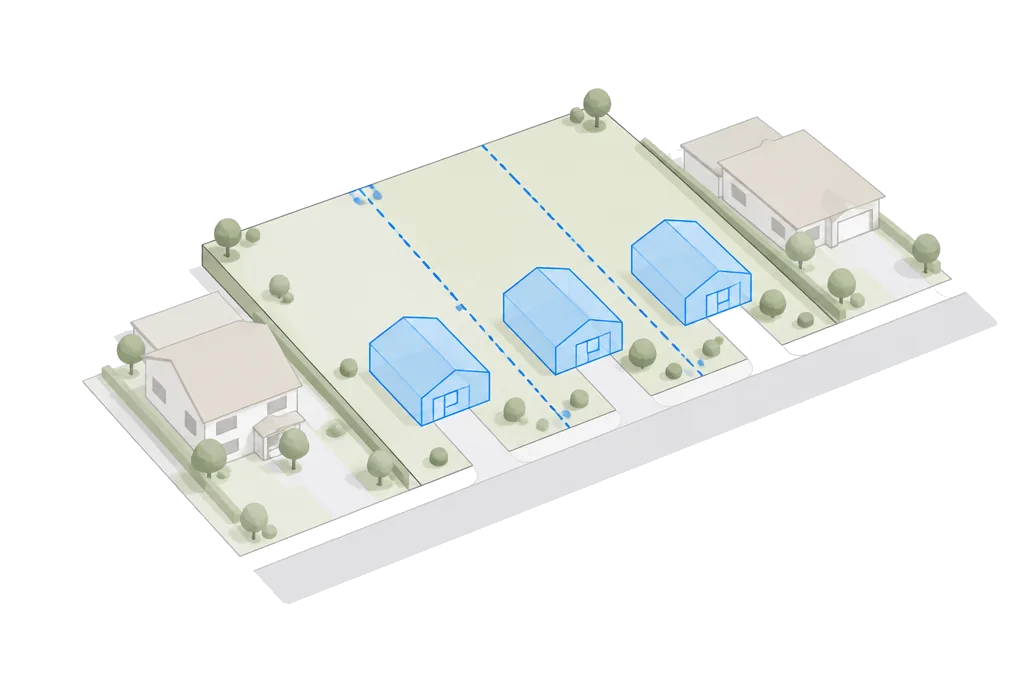
State law on record
One lot-split statute. Two middle-housing laws.
Each row is read from the statute on the official site (read 2026-10-08). The middle column is our summary of the text, not a quote; follow the citation for the law itself.
| State · Law | What the statute allows (summary) | Citation · Read |
|---|---|---|
| California SB 9 — urban lot split | Ministerial parcel map splitting one single-family-zoned parcel into 2 parcels of roughly equal size (each at least 40% of the original and at least 1,200 sf unless local law allows smaller). Each new parcel may carry 2 units of at least 800 sf. | Cal. Gov. Code § 66411.7 Read 2026-10-08 |
| California SB 9 — two-unit housing development | Up to 2 residential units on a parcel in a single-family zone, approved ministerially. Local standards cannot physically preclude 2 units of at least 800 sf each. Setbacks are capped at 4 ft side/rear (0 for an existing structure). | Cal. Gov. Code § 65852.21 Read 2026-10-08 |
| Oregon HB 2001 (2019) middle housing, as renumbered | Large jurisdictions: all middle housing types (duplex, triplex, quadplex, cottage cluster, townhouses) on each lot zoned for residential use. Mid-size cities: a duplex on each such lot. Also requires allowing existing housing to stay while adding units. Middle housing on each lot; it does not divide a lot. | ORS 197A.420 (formerly 197.758) Read 2026-10-08 |
| Washington HB 1110 (2023) middle housing | On all lots zoned predominantly residential: cities of 75,000+ must allow 4 units/lot (6 within 1/4 mile walking of a major transit stop, or 6 if 2 are affordable). Cities of 25,000–74,999 must allow 2 units/lot (4 near major transit, or 4 if 1 is affordable). Cities under 25,000 in the contiguous UGA of the largest city in a county over 275,000 must allow 2 units/lot. Middle housing on each lot; it does not divide a lot. Washington’s 2025 lot-splitting bill (HB 1096) has not been read. | RCW 36.70A.635 Read 2026-10-08 |
Each statute carries conditions the summary leaves out: urbanized-area tests, hazard and tenant exclusions, owner-occupancy and city population tiers. The full report shows the state law beside the Score, and the local standards where we have read the city’s code.
Everywhere else
Local zoning decides.
Outside California’s § 66411.7, dividing a lot is a local decision under the subdivision and zoning code. The variables are the same everywhere; only the numbers change. Check these four before you spend on an architect.
- Minimum lot area. Every resulting lot must meet the district minimum. The Buildability report shows the number for your zoning district where we have read the city’s code.
- Minimum lot width and frontage. Frontage rules often rule out a split even where the area math works. Corner lots carry front-setback rules on both frontages.
- Setbacks after the split. Each resulting lot must meet setback requirements. On narrow lots, the interior side setbacks can leave no room to build.
- Review path: administrative or discretionary. Staff-level approval of a minor subdivision is the most predictable path; a Planning Commission or Council hearing is less certain. The planning counter can tell you which applies.
How to check
Two moves. One for the zoning, one for the record.
A free live check tells you the zoning district and whether a state law may apply. A full report adds the minimum lot size where we have read the city’s code, with the hazard and utility context, in one record. It does not draw the split.
Live zoning check
Free- Zoning district at the parcel, from the city’s own map where it publishes one
- Statewide housing law that may apply (CA, OR, WA)
- No signup, no card
Full property report
$99- Statewide housing law that may apply (CA, OR, WA)
- Minimum lot size where we have read the city’s code (see /atlas)
- Hazard, utility and market context for the parcel
- Written record you can hand your civil engineer or planner
- Free re-runs, and change alerts once it is saved to a free account
Property Reports slide from $99 to $79 at volume. Buildability is preliminary information, not a legal opinion. Confirm with your local planning department before applying.
What landowners actually ask about lot splits.
Can I subdivide my single-family lot?
In California, Cal. Gov. Code § 66411.7 requires a ministerial parcel map splitting a qualifying single-family-zoned parcel in two (summary of Cal. Gov. Code § 66411.7, read 2026-10-08). Outside it, no state lot-split statute is on record here: the local subdivision and zoning code decides, through minimum lot size, frontage and the review path. Buildability reads the zoning district for your parcel in about 20 seconds, and the minimum lot size where we have read the city’s code.
What does SB 9 allow in California?
Two statutes: Cal. Gov. Code § 66411.7 splits one single-family-zoned parcel into two of roughly equal size, and Cal. Gov. Code § 65852.21 allows two units on a parcel, both approved ministerially. For the split, the applicant signs an affidavit to live in one unit for three years, and both statutes apply only where their urbanized-area test is met (summary of Cal. Gov. Code § 66411.7, read 2026-10-08).
Do Oregon and Washington have a lot-split law?
Not one on record here. Oregon’s ORS 197A.420 and Washington’s RCW 36.70A.635 require cities to allow middle housing on residential lots, which adds homes without dividing the lot. Washington’s 2025 lot-splitting bill (HB 1096) has not been read, so nothing is said about it.
How much does a lot split cost?
No statute on this page sets a cost, and no cost is on record here. The survey, the map and the city’s fees are priced locally: ask the planning counter for its fee schedule and a licensed surveyor for a quote.
How long does a lot split take?
Cal. Gov. Code § 66411.7 makes the parcel map ministerial (summary of Cal. Gov. Code § 66411.7, read 2026-10-08). Local review timing is not on record here; the planning counter can tell you its own.
Will the city approve my split?
Under Cal. Gov. Code § 66411.7 a qualifying split is approved ministerially, not at the city’s discretion. Elsewhere the ordinance and the review body decide, and no approval rate is on record here.
Does my lot need to be a certain minimum size?
Under Cal. Gov. Code § 66411.7, each new parcel must be at least 40% of the original and at least 1,200 sq ft unless local law allows smaller (summary of Cal. Gov. Code § 66411.7, read 2026-10-08). Everywhere else the local code sets minimum lot area, width and frontage; the Buildability report shows the minimum lot size where we have read the city’s code.
What about corner lots or irregular parcels?
Corner lots often carry front-setback rules on both frontages, which can rule out a split even where the area qualifies. Flag lots, panhandle lots and lots crossed by easements have constraints the standard rules miss.
Does Buildability work in my area?
Every U.S. address gets its Score. The district comes from the city’s own map where it publishes one, the standards from the code where we have read it (see /atlas), and the CA, OR and WA state laws are shown beside the Score, not inside it.
Due-diligence guide series · 4 guides
More in the series.
Flood insurance due diligence
FEMA zones, floodway and the share of the lot in an SFHA, and insurance basics for land buyers.
Read the guideRadon cost vs. property value
EPA Zones and mitigation cost for investors buying in high-radon counties.
Read the guideLiquefaction risk & soil analysis
USGS ground motion, USDA soils, and the foundation-strategy price ranges.
Read the guide
Read the zoning. Then plan the split.
A $99 report puts the district, the state law and the lot’s record in front of you before you hire a civil engineer.
Free live check · No card needed · All 50 states