
- Due-diligence guides
- Liquefaction
Free tool · No signup
Liquefaction risk, before you commission the geotech.
USGS ground motion and the USDA soil series, read against your parcel in about 20 seconds, before you spend $8,000 on a geotech investigation. Liquefaction itself is the geotech's call.
USGS seismic design category · USDA soils · No signup
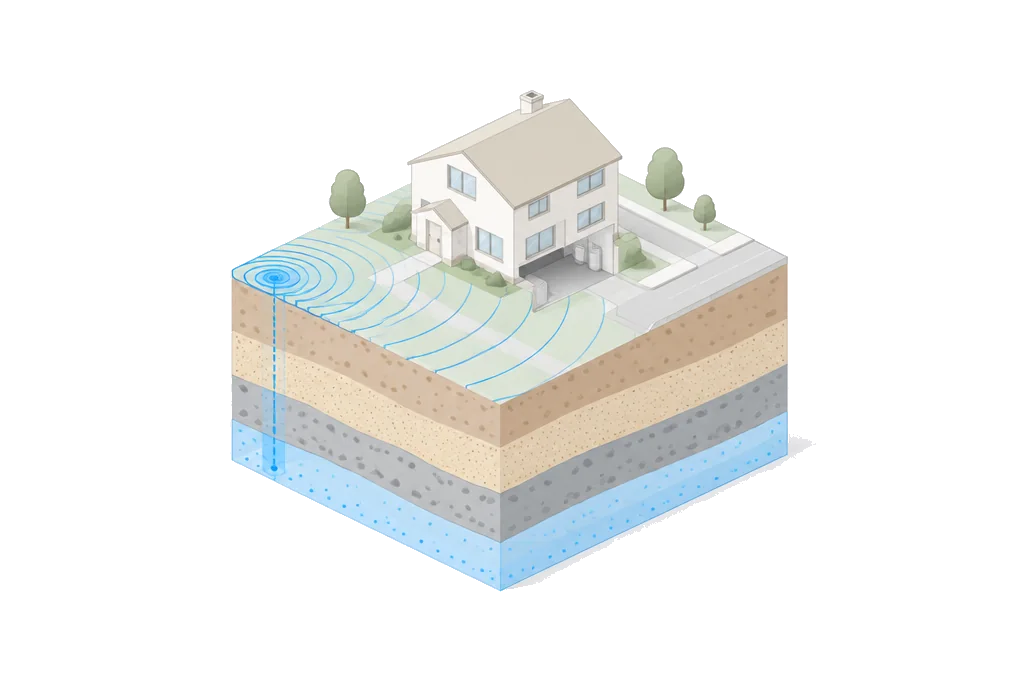
The soil decides
Five soil types, five foundation stories.
Liquefaction is a soil-specific hazard, not a location hazard. A parcel two blocks from severe liquefaction can sit on competent bedrock, and a parcel two blocks from stable neighbors can sit on young bay mud. What the parcel is made of, at depth, determines the foundation cost.
| Soil type | What it means | Liquefaction risk | Foundation strategy |
|---|---|---|---|
| Competent bedrock | Franciscan, granite, dense weathered rock | Not susceptible | Standard shallow foundation |
| Dense sand / gravel | Well-graded, deep water table, high SPT | Very low | Standard footing; verify SPT at depth |
| Loose sand | Shallow water table, low SPT, uniform grain size | Moderate to high | Ground improvement (stone columns, densification) or piles |
| Alluvial fill | Young, saturated, mixed silt and sand. Bay margins, river valleys | High | Deep foundations (driven piles, drilled shafts) required |
| Young bay mud / uncontrolled fill | Historic tideland fill, soft organic clay, marine deposits | Severe. Lateral spreading likely | Deep piles to competent stratum + engineered lateral system |
Soil descriptions are typical characterizations, not a substitute for boring logs. The Buildability report names the USDA soil series at your parcel; a commissioned geotechnical investigation is the binding characterization for design.
What it costs to build there
Three strategies, priced honestly.
On a residential-scale build in a mapped liquefaction zone, the foundation-strategy delta against standard shallow footings is between $15,000 and $120,000+. That is the number that decides whether the deal pencils. Pinned here so the LOI math is real, not aspirational.
- Ground improvement: $15,000 to $60,000. Stone columns, deep dynamic compaction, or vibro-densification stiffen the loose layer in place. Works for moderate risk, shallow liquefiable layer, and low lateral-spread potential. Fastest and cheapest of the three engineered options.
- Deep foundations: $30,000 to $120,000+. Driven piles or drilled shafts transfer load past the liquefiable stratum to competent bearing below. The standard choice for young alluvial fill and bay margins. Lateral loads (spreading) require additional engineering that widens the range.
- Walk away. The honest answer when severe risk meets a deal that does not support the foundation premium.
- Order the geotech only for A/B decisions. A $3,500–$8,000 geotechnical report is the binding number, but it does not make sense to commission on every parcel in your pipeline. Use the free live check first for the soil series and seismic category; order geotech on the parcels that still pencil.
How to check
Two moves. One to screen, one to underwrite.
A free live check tells you the soil series and the seismic design category. A full report adds the SSURGO ratings and every other diligence factor in one file. Neither reads liquefaction.
Live seismic + soil check
Free- USGS seismic design category and peak ground acceleration (site class D assumed)
- USDA soil series at the parcel
- Liquefaction is not read: a geotech report is the binding answer
- No signup, no card
Full property report
$99- Everything in the free check, cited to USGS and USDA
- SSURGO dwelling and septic limitation ratings, depth to bedrock and water table
- Every other Buildability factor: flood, wildfire, zoning, terrain, utilities
- Free re-runs, and change alerts once it is saved to a free account
Property Reports slide from $99 to $79 at volume. Buildability is preliminary information; a commissioned geotechnical investigation is required for design.
What developers and buyers ask about liquefaction.
What is liquefaction?
When saturated loose sandy soils are shaken hard, pore pressure spikes and the soil temporarily behaves like a liquid. Buildings on top settle, tilt, or slide laterally toward lower ground. The 1989 Loma Prieta earthquake liquefaction of San Francisco's Marina District, sand fill placed for the 1915 Panama-Pacific Expo, is the textbook case. Property loss from liquefaction typically exceeds the ground shaking itself in the affected neighborhoods.
How do I know if my property is in a liquefaction zone?
Three data sources tell you: (1) State-published liquefaction hazard maps. California, Utah, Washington, and Oregon have detailed statewide maps. (2) USGS Q-fault and NEHRP site-class data: nationwide coverage, coarser resolution. (3) USDA soil series: young alluvial and marine deposits are the classic red flag. Buildability reads the USGS seismic design category and the USDA soil series in about 20 seconds; it does not read liquefaction maps. A commissioned geotechnical report is the binding answer.
How much does a geotechnical soil report cost?
A residential-scale geotechnical investigation with 2–3 borings runs $3,500–$8,000 typically, with the deeper end reflecting more borings and lab testing (SPT, atterberg limits, gradation). Commercial projects run $10,000–$50,000+ depending on scope. Buildability's live check is not a substitute; it names the soil series and the seismic design category before you spend the money.
What are the foundation options in a liquefaction zone?
Three practical strategies. (1) Deep foundations: driven concrete or steel piles, or drilled shafts, that transfer load to competent stratum below the liquefiable layer. Adds $30,000–$120,000+ to a residential build. (2) Ground improvement: stone columns, deep dynamic compaction, or vibro-densification that stiffens the loose soil in place. $15,000–$60,000 typical residential. (3) Walk away: the honest answer when the site's severe and the deal math doesn't support the foundation premium.
Does liquefaction risk affect property value?
Yes, and it's usually already priced in for buildable sites in mapped zones; comparable sales reflect the required foundation premium. The value hit is worst on parcels that were bought before disclosure requirements and are now hard to insure or hard to sell without a geotech report in hand. In California, natural-hazard disclosure statements have had to name liquefaction risk since 1998.
What is lateral spreading?
A specific liquefaction failure mode where the liquefied layer flows downslope, dragging structures with it. Bay margins, riverbanks, and lake edges are the classic settings. It's not just settlement: the ground moves horizontally toward the free face, and buildings crack, tilt, or slide off their foundations. Where lateral spreading is possible, deep piles alone are not enough; the design has to resist the lateral drag.
Is liquefaction the same as ground shaking?
No. Ground shaking is the direct effect of seismic waves; every parcel in a seismic zone experiences it. Liquefaction is a soil-specific response that happens only where the shaking, the water table, and the soil type all line up. A parcel with high PGA on competent bedrock has strong shaking risk and low liquefaction risk. A parcel with moderate PGA on young bay mud has moderate shaking risk and severe liquefaction risk. They price different fixes.
Do lenders require liquefaction disclosure?
In California, the Natural Hazard Disclosure Statement covers state-mapped liquefaction zones and must be delivered to residential buyers. Elsewhere, requirements vary by state. Commercial and institutional lenders routinely order Phase I environmental and geotechnical work regardless of disclosure requirements; residential lending typically does not, which is why serious buyers verify independently.
Does Buildability work in my area?
Yes, all 50 states. USGS seismic data and USDA soils cover every U.S. address. Liquefaction zones are not read.
Due-diligence guide series · 4 guides
More in the series.
Flood insurance due diligence
FEMA zones, floodway and the share of the lot in an SFHA, and insurance basics for land buyers.
Read the guideRadon cost vs. property value
EPA Zones and mitigation cost for investors buying in high-radon counties.
Read the guideLot subdivision rules by state
Statewide pre-emption (CA/OR/WA) versus local zoning, plus the cost and timeline of a split.
Read the guide
Screen before you geotech.
A $99 report puts the soil and seismic record for this parcel in front of you before you spend $8,000 on a geotechnical investigation.
Free live check · No card needed · USGS + USDA