
Zoning analysis · tied for the heaviest factor
The zoning code, decoded.
Designation, permitted uses, setbacks, height, FAR, ADU eligibility. The buildable envelope for any U.S. parcel, in plain English, in about 20 seconds.
Free to score · No signup · Every factor cited
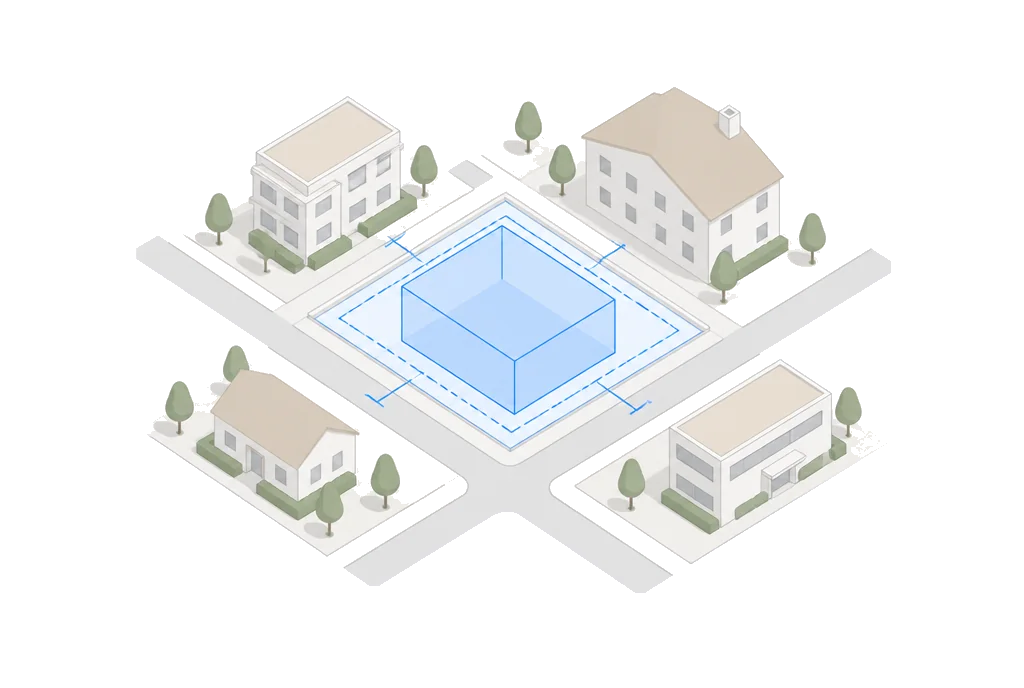
From a district name to a buildable volume.
The envelope for the site-wide sample parcel: the same SF-3 lot the homepage scores, overall 89 · A, IC-ready.
| Standard | Sample parcel · Austin metro · SF-3 |
|---|---|
| Designation | SF-3 · Family Residence |
| Max height | 35 ft |
| Front setback | 25 ft |
| Side / rear setback | 5 ft / 10 ft |
| Max FAR | 0.4 |
| Max lot coverage | 40% |
Zoning sub-score ×14% weight: 85 / 100
- Single-family, by right. Permitted outright. No hearing, no conditions.
- Duplex, conditional use. Allowed with an approval step. The real risk is the hearing timeline.
- ADU, eligible. An accessory dwelling unit is on the table for this district.
From ordinance to envelope.
Five findings, in the order a deal needs them. Each one cited, none of them a judgment call.
- 01
Designation and district.
The code (SF-3, R-2, C-1) resolved for the exact parcel boundary, not a radius guess, from zoning partners and municipal records.
- 02
Permitted and conditional uses.
What you can build by right and what needs a hearing, labeled in plain English instead of ordinance cross-references.
- 03
The buildable envelope.
Setbacks, height limit, FAR, and lot coverage. The numbers that turn a district name into a buildable volume.
- 04
ADU eligibility.
Whether an accessory dwelling unit is allowed on the lot. The question homeowners and infill builders ask first.
- 05
The score input.
The dimensional standards become the zoning sub-score inside the Buildability Score™, weighted 14% by default, tied with flood and behind only terrain.
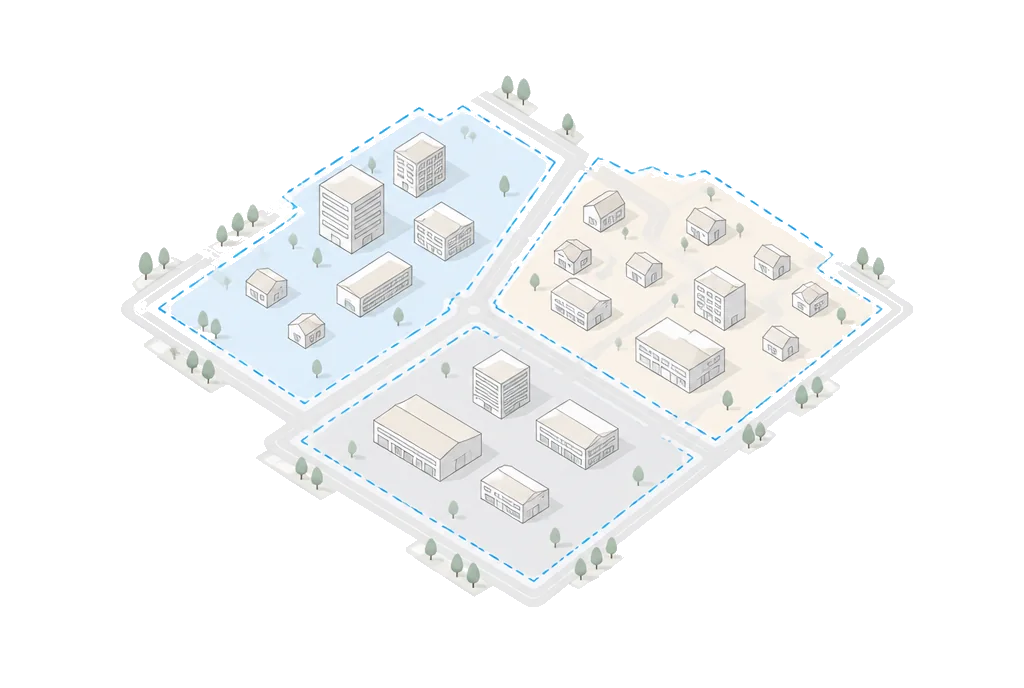
Decoded from zoning partners and municipal records, grounded on the exact parcel. Audit the sources
One factor. 14% of the verdict by default.
Zoning is tied with flood for the heaviest default weight in the Buildability Score™ behind terrain, and Geo answers zoning questions by running the real engine.
Representative session. Every figure is a real tool run on the live engine.
14% of the verdict
Zoning is one of the heaviest factors in the Buildability Score™ by default: tied with flood, ahead of soil and utilities, behind only terrain.
Unknown is dropped, not faked
When dimensional standards cannot be resolved, the factor drops out of the score entirely and the report says so. A designation name alone is never scored, and nothing is invented.
Test the upzone
Geo's run_scenario tool re-scores the parcel under an upzone. The before and after delta shows what the entitlement is worth.
City hall, held against one report.
What decoding a district by hand costs, beside one report.
| Reading the code yourself | With Buildability™ | |
|---|---|---|
| Time to an answer | 2–3 weeks of calls and PDFs | About 20 seconds |
| Cost per parcel | $2,500–$5,000 consultant memo | $99, $79 at volume |
| Format | Ordinance text, read by hand | Plain-English envelope |
| Uses | Cross-referenced across code sections | By-right and conditional, labeled |
| Citations | Rarely included | Every finding names its source |
A screening standard, not a substitute for entitlement counsel on the deal you pursue.
Zoning history and variance odds, read as a screening signal.
The zoning weight is not just a compliance check. It reflects four jurisdictional factors that decide whether a variance is likely, likely with work, or a dead end. Directional, not probabilistic.
Staff-level (ministerial) approval is the fastest and most predictable path. Planning Commission with a Council vote is the slowest and least certain. The report flags which path applies for the specific request type on the parcel.
A jurisdiction that has upzoned in the last five years or granted variances at the parcel scale tells you where the entitlement fight lands on the risk curve. Cities with a frozen pattern signal higher entitlement cost and timeline; cities with active reform signal the opposite.
Codes that spell out objective standards (specific numbers for setback, height, FAR) make ministerial paths possible. Codes that lean on discretionary language (“appropriate,” “compatible,” “in keeping with”) force every project through the discretionary funnel. The report reads the specific ordinance and scores this directly.
Where SB 9 (CA), HB 2001 (OR), or HB 1110 (WA) apply, the statewide right overrides the local discretion. The report flags pre-emption applicability so the entitlement strategy is scoped correctly from the start. A ministerial statewide path is often faster than a discretionary local path.
Approval-path signals are directional, not probabilistic. Buildability is a developer's screen before entitlement counsel, not a substitute for it.
Before you decide.
Where does the zoning data come from?
Zoning and entitlement partners plus municipal code records, resolved against the exact parcel boundary. Every finding cites where it came from.
What does the analysis include?
Designation, permitted and conditional uses, setbacks, height limit, FAR, lot coverage, and ADU eligibility. The dimensional standards feed the zoning sub-score, weighted 14% of the Buildability Score™ by default.
What if zoning cannot be determined for my parcel?
The factor drops out of the score entirely and the report says so — the remaining factors carry the verdict. A designation name alone is never scored, and nothing is guessed or invented.
Can I test a rezone before pursuing it?
Yes. Ask Geo “what if we upzone?” and the run_scenario tool re-scores the parcel under that lever, returning the score and unit-count delta.
Is this legal or entitlement advice?
No. It is a screening standard. Use it to kill bad sites fast, then verify with the jurisdiction and counsel on the deal you pursue.
What does it cost?
The live Score is free: every factor, cited, no card. After that, one report ($99, sliding to $79 at volume) buys the full report.

Know the envelope first.
Designation, uses, setbacks, height, FAR, and ADU eligibility for any U.S. address, in about 20 seconds.
Free to score · Full report $99 · All 50 states