
Compare · Property scores
Two scores, two questions.
First Street scores the natural hazards facing a property. The Buildability Score™ composes hazard and zoning into one number, with setbacks, FAR and by-right rights where the city’s code has been read. Neither replaces the other. The right one depends on the decision.
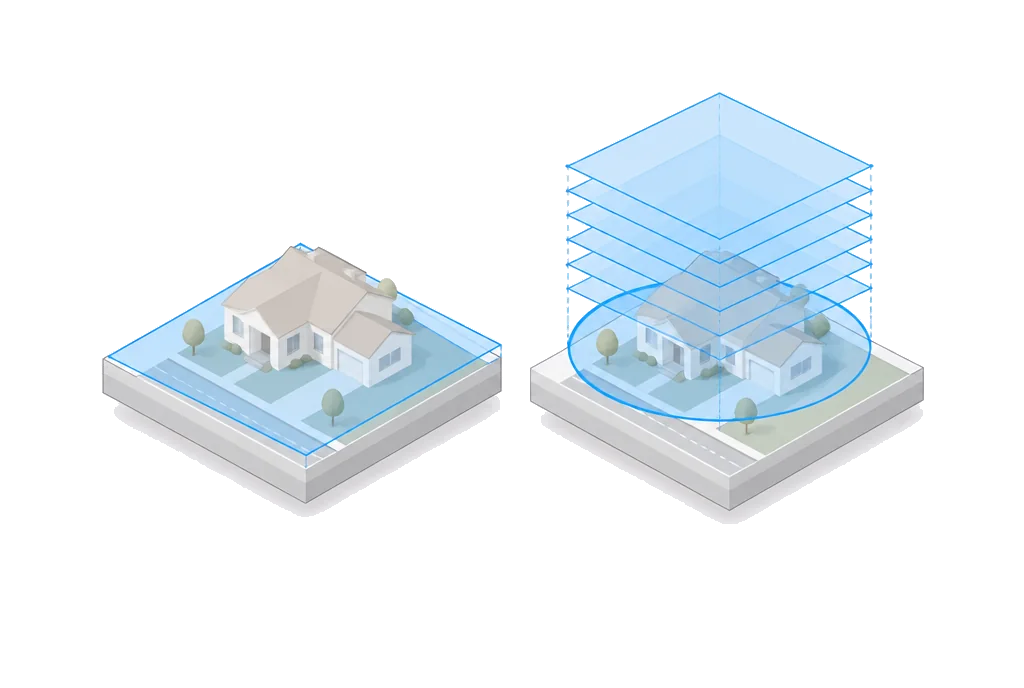
Head-to-head
What each score actually answers.
Two established methods, aimed at two different decisions. Both true at once.
| First Street | Buildability Score™ | |
|---|---|---|
| Core question | What natural hazards face this property? | Can I build here, and what? |
| Axis | Hazard only | Hazard + permission, composed |
| Score range | 1–10 per factor | 0–100 composite |
| Factors scored | Flood, Fire, Wind, Heat, Air (5) | Zoning, flood, seismic, soil, radon, wildfire, utilities, terrain, and lot geometry (9) |
| Zoning & permitted uses | Not scored | FAR, setbacks, coverage, ADU eligibility, where the city's code has been read |
| By-right building rights | Not scored | Jurisdiction-specific, where the city's code has been read |
| Source model | Peer-reviewed physical science models | Weighted overlay suitability (GIS-MCDA), capped by landmines |
| Distribution | Redfin, Realtor.com, API, bulk data | buildability.us, embeddable widget |
| Primary users | Buyers, lenders, insurers screening climate exposure | Developers, investors, homeowners screening build feasibility |
Give both their due
What each does extremely well.
No disparagement. First Street's science is genuinely hard to match; the Buildability Score™ answers a different question with an established GIS-MCDA method (McHarg, 1969). The Score itself is not peer reviewed.
First Street
Peer-reviewed climate risk science, at national parcel scale, distributed where buyers already look.
- Peer-reviewed models built with 80+ scientists
- National parcel-level coverage across five hazard factors
- Distribution on Redfin and Realtor.com listings
- Transparent methodology, published openly
Buildability Score™
The composite that names both physical and regulatory constraints in one score. The number that matches a build decision.
- 9 factors spanning hazard AND permission
- Live queries to 7 federal agencies, cited per finding
- Zoning scored; setbacks, FAR and ADU rules where the city's code has been read
- Score caps when a single factor determines the outcome
Worked scenario
An ADU on a coastal lot.
A homeowner in Sarasota, Florida wants to add a detached ADU. Two questions follow, one for each score.
- 01
Question 1. What is the flood risk?
First Street's Flood Factor answers this. Sarasota has significant coastal exposure. The homeowner sees a 1–10 Flood Factor on Redfin or Realtor.com, understands the 30-year cumulative flood probability, and decides whether flood insurance cost is a deal-breaker.
- 02
Question 2. Can I build an ADU here, and how?
First Street does not answer this. Buildability™ does. Where we have read the city's code, it checks whether the parcel's zoning permits ADUs by right, what setbacks apply, whether the ADU footprint would exceed lot coverage limits, and what FAR the zone allows. Everywhere, it reports how much of the lot sits inside the mapped Special Flood Hazard Area.
- 03
Full picture. Both scores.
The homeowner who checks both scores arrives with the full picture: the physical risk they are accepting and the regulatory envelope they are building inside. Neither score alone gives them that.
Method lineage
Not a new score. A 57‑year‑old method, operationalized live.
The Buildability Score™’s underlying method is weighted overlay suitability analysis, the technique Ian McHarg formalized in Design with Nature (1969), documented in 300+ peer-reviewed GIS-MCDA papers, and taught in every planning school in the country. What is new here is the operationalization: parcel granularity across all 50 states, live-queried federal sources, and the composition of hazard and permission axes into one score per parcel.
Frequently asked questions.
Is Buildability™ trying to replace First Street?
No. First Street answers a hazard question at a level of scientific rigor and peer review that took years and more than 80 scientists to build. We are in the feasibility business — composing hazard data (including FEMA's, which we query directly) with permission data. The products answer different questions for different decisions.
Which score matters more?
It depends on the decision. For a lender underwriting flood insurance cost, First Street's Flood Factor is the relevant number. For a developer deciding whether to make an offer on a parcel, the Buildability Score™ is more decision-relevant because it prices in both physical and regulatory constraints. For a buyer who wants to build: they need both.
Do you use First Street data inside the Buildability Score™?
The complete data-sources list is on the Data Sources page — federal APIs, commercial partners, and any modeled layers are named there. The hazard factors query FEMA, USGS, EPA, and USDA directly, which are the same underlying government datasets First Street's peer-reviewed models are built on top of.
If I have a high First Street Flood Factor, will my Buildability Score™ be low?
Not necessarily. Flood is weighted into the parcel score at 16% by default (25% in Florida). A lot with significant flood exposure can still score well if the other factors are strong and less than half the lot sits in the SFHA; a majority-SFHA lot or a regulatory floodway caps the score outright. What you will see is a low flood sub-score, a named finding citing the FEMA source, and an overall Score that reflects the drag.

Score any property free.
Hazard plus permission, cited to source, in about 20 seconds.
No signup required · All 50 states · Federal sources cited